Priceless
Leither MagazineMagazine
The Leither
Leith Writings
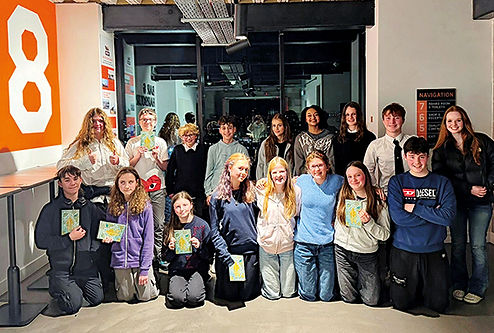
The writers take a well-deserved bow
The Silence in Between
Charlie Ellis on Finding Connection in the Flow of Experience
Why do we write? One of the best explanations came from cultural theorist Richard Hoggart (1918 - 2014) in his 1971 Reith Lectures (Only Connect):
‘we write first for ourselves, for a more secure sense of ourselves, so as to hold steady a bit more of experience, so as to feel less swayed all ways by the flow of experience…we hope that this effort, this sort of exploring, will help us reach more convincing ways of speaking to each other…we best speak to others when we forget them and concentrate on trying to be straight towards our experience’.
Hoggart’s profound words immediately sprang to mind while exploring the fifth anthology of Leith Writings, The Silence in Between. The volume powerfully exemplifies Hoggart’s core belief in connecting literacy to personal, community, and cultural lives.
Authenticity and Exchangeability
Richard Hoggart’s observation that ‘honestly seen experience becomes exchangeable’ provides the perfect framing for The Silence in Between. This anthology brings together 32 pieces of deeply reflective prose and poetry by a varied group, including talented local school pupils. Much like the anthology, Hoggart’s own distinguished writing was engrossed in everyday life and characterised by a powerful sense of place, exemplified by his classic exploration of working-class life, The Uses of Literacy.
The value of Hoggart’s deeply observant approach was highlighted at the collection’s launch event by Bethany Robb, English teacher at Trinity Academy. She emphasised that ‘gathering material for this exercise involves being observant, curious and imaginative in your surroundings, all good literacy skills for young people to develop early in life’.
Leith’s Rebirth
These aspects of Hoggart’s work - place, change, and community - are powerfully present in The Silence in Between. In his introduction, local historian Stephen Dickson suggests the contents ‘perhaps represents an evolution in the thoughts of the area,’ especially regarding the many ‘New Leithers’. Dickson feels the area has been ‘reborn’ since the 1980s and concludes the volume shows Leith has a ‘character that is unequalled in any other town or area’. The volume emphatically dismisses the notion that the area has been altered beyond recognition. The authors see no contradiction between embracing long-surviving elements (like the waterways, which rightly feature prominently) and welcoming newcomers. The writing encapsulates a strong sense that Leith’s future is as rich and promising as its past.
The Liminal Tone and Young Voices
The project’s driving force, Tim Bell (the Trainspotting scholar), was impressed by the ‘parade of talent’ provided by the school pupils involved. A key feature is that youthful work sits proudly alongside established authors, breaking down creative barriers. Bell hopes this plants a seed, showing pupils they can produce something substantial for a wider audience. To those who didn’t get included, ‘you shouldn’t be too disappointed’. Most importantly, ‘Don’t stop writing’.
Bell highlighted Sophie Arthur’s powerful poem, The Quiet in Between, calling it, rightly, “a hell of a poem for a teenager”. Key lines encapsulate the mood:
‘a junction after all, is never a choice; it is the stillness before turning, the ache of remaining and the quiet in between’
This liminal character typifies the collection’s tone, inspired by the theme of Great Junction. Nile Collins Fraser’s poem Junctions speaks of how ‘the actions we take are the fork in the path’. This reflects a more general sense that we are currently in an era of flux, a period of liminality with little clear sense of where we are headed. Our society is at a junction.
This feeling is powerfully captured in Norman Oyoo’s cover art, which depicts one of Antony Gormley’s figures falling back into the Water of Leith, struggling to keep its head above water - a striking reflection of the daily struggles we all face to stay afloat.
As in Hoggart’s sociological writings, the zeitgeist is captured and reflected here. Sophie Arthur’s piece also inspired the title for the entire collection, with ‘silence’ deriving from the reflective character of a number of the submissions. We are all, perhaps, in need of more silence and reflection. Spending an hour or so absorbing the contents of The Silence in Between would be a good place to start.
The Defence of the Everyday
Bell admitted one tension: whether it’s right for teenagers’ work to sit alongside those with adult themes. I’d argue that while some language is ‘direct,’ it shows unpleasant realities, not shock value. Hoggart famously defended Lady Chatterley’s Lover in 1963, asserting its high literary and moral seriousness. The ‘plain speaking’ style in The Silence in Between can be defended on similar literary grounds, as is clear in Pat McGarvey’s ‘The Creature under the Bridge’, which is rich with authentic Leith vernacular. The themes are very current, of friends caught up in online conspiracism. Powerfully, the narrator reflects ‘this wasn’t what they’d gone on strike for all those years ago’. This echoes Hoggart’s 1982 warning about entering the ‘information age’ with ‘wholly inadequate social and cultural compass and rudder’.
Hoggart treated the everyday as deserving of literary scrutiny. This is prominent here, nowhere more so than in Mav McKinstrie’s The Junction, which builds drama from buses surging by, ‘pungent aromas’ from drains, and suspicious supermarket pastries. This piece and others in the collection elevate the significance of people and subjects often ignored or marginalized.
Culture and Refuge
Hoggart strongly supported a well-funded cultural sector, viewing public libraries as a crucial, non-commercial space and the ‘special refuge of the misfits and left-overs’. Such figures are well represented here, including Matthew Clater-Loeb’s piece contrasting the ‘street of culture’ below with a man’s life falling apart, heading to a ‘grim destination’.
Hoggart saw good literature’s accessibility contrasting sharply with the commercialised ‘mass culture’ he criticised. This community-produced volume - printed by Leith’s own Out of the Blueprint - fits the mode of ‘self-created’ culture, which he saw as having fundamental integrity. The Silence in Between offers a reflective pause in today’s rush, echoing Hoggart’s plea to stay ‘straight towards experience’.
Pick up a copy of The Silence in Between at Argonaut Books, Leith Library, McDonald Road Library, or Out of the Blue on Dalmeny Street. To donate to the project and (in due course) find details on the next edition visit: leithwriting.com
I'm a paragraph. I'm connected to your collection through a dataset. Click Preview to see my content. To update me, go to the Data

I'm a paragraph. Click here to add your own text and edit me. It's easy.
I'm a paragraph. Click here to add your own text and edit me. It's easy.
Xyxyyxyx xyxyxyyxyxy xyxyxyxy
"
