Priceless
Leither MagazineMagazine
The Leither
Politics & People
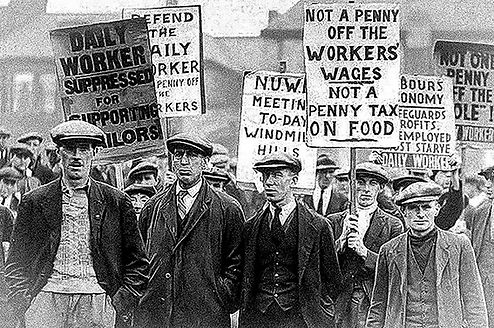
Strikers rallying for the 1926 General Strike
Nine Days in May
On the centenary of the 1926 British General Strike, less than 25% of UK workers are protected by trade union membership writes Mike Cowley
The causes are many, and often approached in isolation rather than as an interconnected matrix of drivers. Anti-union laws, a more individualistic culture, a post-industrial landscape of precarious, part time and temporary work and a relentless ideological offensive against the concept of collective solidarity have served to corrode the capacity of a movement built upon the principle that an Injury to One is an Injury to All.
In 1926, the horrors of the First World War remained a vivid memory for millions of young men and women. They returned to the home front to be met not with the spoils of imperial victory, but by the same grinding poverty they left for the trenches of Europe. With most women still to win the franchise and the NHS a twinkle in the eye of a young Welsh coal miner called Aneurin Bevan, the post war period was fertile ground for the sowing of social discontent, and more importantly, visions of a more just world.
At 11.59pm on the 3rd May, the Trades Union Congress (TUC) called for the withdrawal of labour across transport, electricity, gas, docks, heavy chemicals, building and printing, all in solidarity with British miners locked out their pits for refusing to accept lower pay and longer hours. ‘Not a minute on the day, not a penny off the pay’ was their rallying slogan. Only nine days later, the strike was over.
The miner’s leader, AJ Cook, described the TUC’s capitulation as ‘a complete surrender.’ The miners battled on for another seven months, eventually being forced back to work on the precipice of destitution and starvation.
Despite (perhaps to a degree because of), the strike’s defeat, those events have passed into working-class folklore, inserted into a narrative of grassroots conviction brought low by the cowardice of a national leadership unwilling to entertain the revolutionary implications of working people bringing the country to a juddering halt.
Leith can claim its own genealogy of craft guilds and trade unions from the Middle Ages onwards. Guilds protected not only skilled workers like tailors, but their customers from inferior goods. One incident from May 10th 1926, 7 days after the strike was called and only 3 before its abrupt cessation, places Leith within a tale remembered as the St Margaret’s Railway Crash.
The General Strike saw 460,000 railway workers down tools. In an attempt to break the dispute, under police guard, blacklegs provided a skeleton and inexperienced staff. In an effort to derail a slow moving coal train, a group of Northumbrian miners removed a rail on the East Coast Mainline. Instead, it was the Flying Scotsman travelling from Edinburgh to London that came crashing off the rails. Only minor injuries resulted.
However, against a background of sensationalist popular coverage, only an hour later a more devastating but less well accounted for incident occurred on the same line, when a passenger train travelling between Berwick-Upon-Tweed and Edinburgh collided with a goods train placed in its path at St Margaret’s Depot in Edinburgh. St Margaret’s was penned in between Piershill Junction and the line to Leith. Three people lost their lives and thirteen were hospitalised. The event remains a lesser known clash in a class war that erupted across the country in 9 short but angrily contested days.
Until recent decades, trade union consciousness remained deeply embedded in industrial communities across the UK. Solidarity was a form of political capital essential to communities mired in poverty and sent into treacherous working conditions daily. In our fractured present of extreme individualism, it is tempting to romanticise a history where industrial exploitation fused workers and their families to enduring social bonds rooted in class identity.
For instance, trade unions were dominated by male concerns and priorities. Misogyny and racism were not uncommon within the wider labour movement. But in US Sociologist CW Mill’s terms, the industrial working class could not help but see its ‘private troubles’ as ‘public issues.’ Solidarity was a matter of life and death, not simply a galvanising call to arms. Stepping outside your ‘private orbit’ and grasping your place in the world as indivisible from the historical period you were en-twinned with did not require intellectual persuasion. It was a lived and mobilising truth to millions of workers across the UK.
In Britain alone, around 20% of the adult population are prescribed a psychiatric drug in any one year, a 500% increase since 1980, a ‘morbid symptom’ of a society where loneliness is a silent epidemic. The 1926 General Strike failed to achieve any of its key demands. But 100 years later, the fact that hundreds of thousands of ordinary workers were prepared to stop the clocks in solidarity with people they had never met frames the event in mythic terms.
In an age where the metrics of our lives are more and more calculated by fiscal cost, where homes are recast as ‘property’ and human relationships, often mediated through the online attention economy, are increasingly transactional, 1926 reminds us that when ordinary people act in concert, the world stops turning. At that point, as David Graeber put it, ‘we could just as easily make it differently.’
The Edinburgh, Lothians and Borders May Day march and rally assembles at Johnston Terrace by the castle on Saturday, May 2nd. It marches off at midday and ends up at the Pleasance where there will be stalls an open cafe and the rally which starts at 1pm
I'm a paragraph. I'm connected to your collection through a dataset. Click Preview to see my content. To update me, go to the Data

I'm a paragraph. Click here to add your own text and edit me. It's easy.
I'm a paragraph. Click here to add your own text and edit me. It's easy.
Xyxyyxyx xyxyxyyxyxy xyxyxyxy
"
